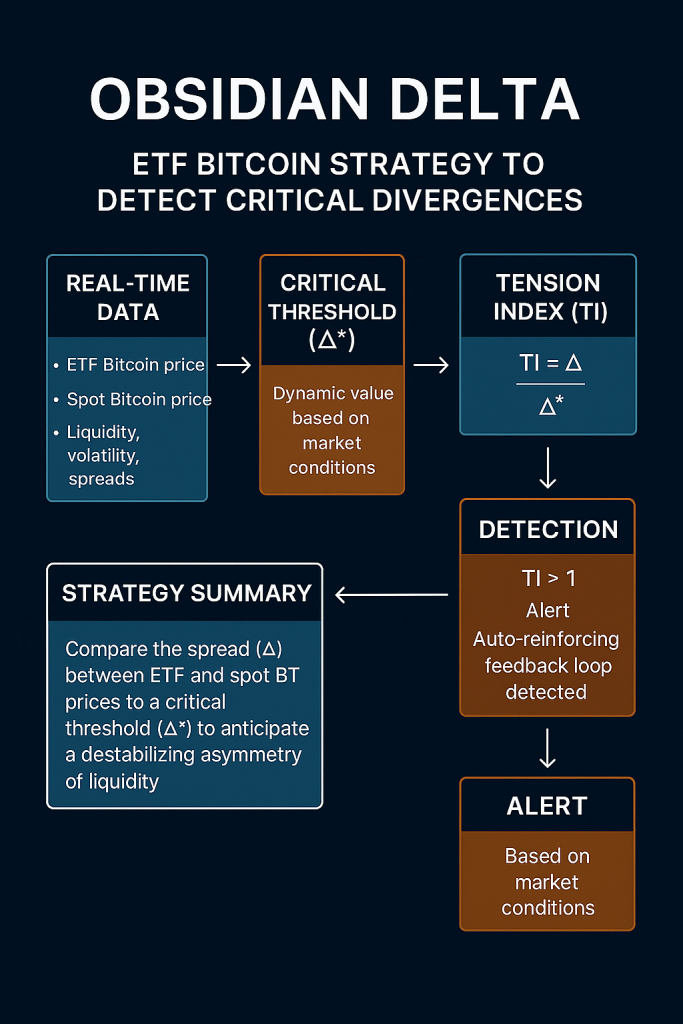
Bitcoin ETF Liquidity Asymmetry Framework
Obsidian Delta is a proprietary market-structure research framework designed to monitor liquidity asymmetries between Bitcoin spot markets and Bitcoin ETF ecosystems.
The framework focuses on ETF flow dynamics, spot-market absorption capacity, liquidity fragmentation and potential dislocations between synthetic exposure and underlying Bitcoin liquidity conditions.
Obsidian Delta combines cross-market liquidity analysis, ETF flow monitoring and stress-validation layers to identify nonlinear market conditions that may emerge during periods of accelerated capital rotation or structural liquidity imbalance.
The framework is designed for macro research, market diagnostics and institutional monitoring purposes rather than direct investment solicitation.
Core Architecture
The Obsidian Delta framework integrates several adaptive monitoring layers designed to detect liquidity stress, ETF-flow imbalance and structural market asymmetries between Bitcoin spot and ETF ecosystems.
The framework notably integrates:
- ETF Flow Absorption Layer (EFAL): monitors ETF inflows relative to estimated spot-market absorption capacity.
- Liquidity Dislocation Index (LDI): measures divergence between ETF pricing dynamics and underlying spot-market liquidity conditions.
- Institutional Tension Assessment (ITA): evaluates structural stress generated by accelerated ETF demand relative to available market liquidity.
- Validation Layer (VL): filters short-term noise and validates structural regime shifts through cross-market confirmation signals.
Strategic Purpose
Obsidian Delta was developed to monitor structural liquidity asymmetries emerging between Bitcoin spot markets and the rapidly growing ETF ecosystem.
The framework is designed to identify nonlinear stress dynamics, absorption-capacity imbalances and institutional-flow distortions that may not be immediately visible through conventional market indicators.
Obsidian Delta is intended for macro research, systemic monitoring and quantitative strategy development purposes rather than direct investment solicitation.