Systemic Risk & Black Swan Monitoring Framework
Obsidian Swan is a proprietary macro research framework designed to monitor systemic risk, market fragility and extreme-event dynamics across financial markets.
The framework combines macro-financial indicators, market stress signals, liquidity conditions and validation layers to support a structured reading of potential regime shifts.
Obsidian Swan is not an investment product, but a research and decision-support architecture developed for macro analysis, risk monitoring and quantitative strategy design.
Why Traditional Risk Models Fail
Traditional market risk models are often optimized for normal market conditions and historical volatility structures. However, periods of systemic transition, liquidity fractures and macroeconomic instability tend to generate nonlinear market dynamics that conventional frameworks struggle to detect early.
Obsidian Swan was designed to address these structural blind spots by combining macro-financial stress analysis, liquidity monitoring and adaptive validation layers within a unified research architecture.
Core Architecture
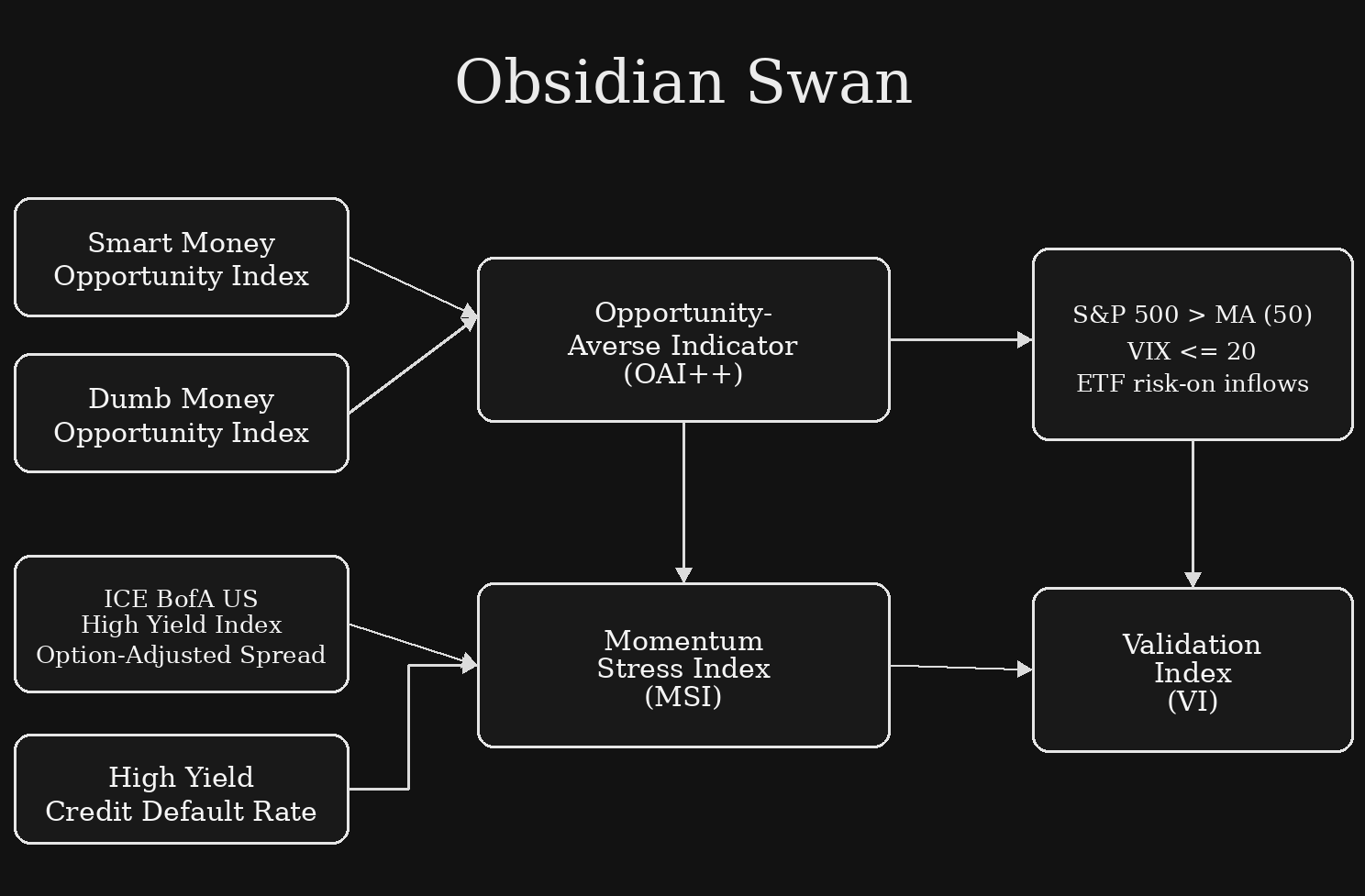
The Obsidian Swan framework is structured around multiple adaptive monitoring layers designed to detect systemic fragility, market stress escalation and nonlinear transition dynamics across financial markets.
The framework notably integrates:
- OAI++ (Opportunity Aversion Index)
A proprietary indicator designed to evaluate shifts between speculative appetite and systemic risk aversion across macro-financial environments. - MSI (Market Stress Index)
A multidimensional stress-monitoring layer combining volatility conditions, liquidity deterioration, credit stress and market structure instability. - VI (Validation Index)
An adaptive validation layer designed to filter noise, strengthen signal robustness and improve contextual interpretation during unstable market regimes.
Together, these layers form a dynamic macro-risk architecture intended to support systemic monitoring, regime-shift analysis and advanced market diagnostics.
Monitoring Layers
Obsidian Swan continuously monitors multiple macro-financial and market-structure dimensions associated with systemic instability and regime-transition environments.
The framework notably tracks:
- Liquidity stress and funding deterioration
- Volatility expansion and convexity dislocations
- Correlation instability across asset classes
- Credit market stress and spread deterioration
- Macro-financial fragility and policy divergence
- Risk-aversion acceleration dynamics
- Market structure deterioration and instability signals
The objective is not to predict isolated market events with certainty, but to identify environments where systemic fragility and nonlinear risk dynamics become increasingly dominant.
Use Cases
Obsidian Swan was designed as a macro-financial research and monitoring architecture intended to support advanced market interpretation during unstable or transitional market environments.
Potential applications include:
- Systemic risk monitoring
- Regime-shift identification
- Liquidity deterioration analysis
- Macro risk-environment assessment
- Portfolio stress contextualization
- Cross-asset fragility monitoring
- Adaptive macro-allocation research
- Tail-risk and convexity analysis
The framework is intended to complement broader macroeconomic, quantitative and discretionary research processes rather than replace traditional investment analysis.
Research Philosophy
Obsidian Swan is built on the idea that modern financial markets are increasingly shaped by nonlinear dynamics, reflexive behavior, liquidity feedback loops and macroeconomic regime transitions.
Traditional equilibrium-based approaches often underestimate the importance of systemic fragility, convexity effects and liquidity deterioration during periods of structural instability.
The framework therefore combines macroeconomic interpretation, market-structure analysis and adaptive quantitative monitoring within a unified research architecture designed to evolve alongside changing market environments.
Rather than relying on static assumptions, Obsidian Swan seeks to identify evolving risk structures and contextual shifts capable of altering the stability of financial systems and cross-asset behavior.
Restricted Research Layer
Certain advanced monitoring layers, proprietary diagnostics, extended analytics and research outputs associated with the Obsidian Swan framework may be reserved for restricted or professional access.
This may include advanced monitoring dashboards, research publications, macro-risk reports and institutional research material developed within the broader Meschi Capital Partners research architecture.